
Clinical Trials for Non-Scientists: Part 1 – Pre-IND
The work required for a drug to reach the first phase of clinical trials

To welcome autumn, I’m going to be starting a new series describing the steps of clinical trials, why each are important, and how they’re used by the FDA to eventually approve new medicines. The goal of this series is to clarify how drugs come to market and emphasize why this is important. Welcome to Part 1: everything that happens before a drug can reach phase 1 clinical trials, and why it’s important.
Drug Discovery has become increasingly challenging
Drug discovery and development is notoriously difficult. As in more difficult than building a rocket and with a fraction of the success rate. Clinical trials are studies that test new interventions in humans. Of all the drugs that reach clinical trials, only 12% go on to become FDA (U.S. Food and Drug Administration) approved. These clinical trials take around 10-15 years and cost and drugs cost range to up to 2.3 billion $.
This isn’t even the hard part. The hardest part is identifying targets in disease and chemical entities that actually make a difference in disease states. It is hard to understand how diseases work and finding a druggable target in patients. Thus comes the “research” of the research and development (R and D) sector of the pharmaceutical industry. Most of the time, the pharmaceutical industry reads published academic papers from university labs and employs contract research organizations to perform experiments or acquires biotechs with drug candidates. However, some diseases remain elusive. Take Alzheimer’s for example: more than 200 investigational programs have failed or been abandoned in the last decade [1]. Only last year did the FDA approve a new drug to treat Alzheimer’s that decreases disease progression by 27% after 1.5 years of dosage.
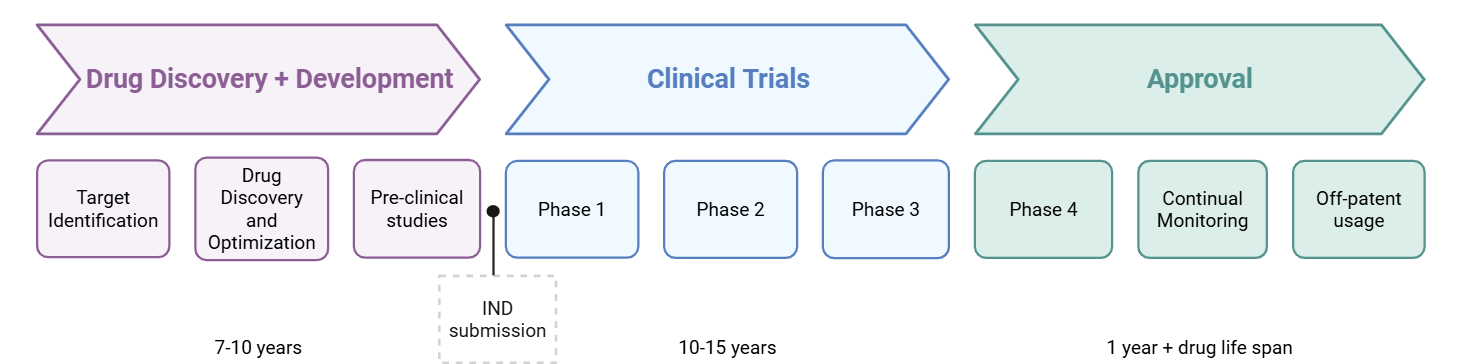
After the discovery of a drug, the medicine is then subjected to clinical trials before review and release on to the market. However, before testing in humans, the pharmaceutical company must first file an investigational new drug application (IND). But what truly defines a drug?
According to the FDA a drug is:
“a substance recognized by an official pharmacopoeia (like a dictionary for drugs)
a substance intended for use in diagnosis, cure, mitigation, treatment, or prevention of disease
a substance (other than food) intended to affect the structure or any function of the body
a substance intended for use as a component of a medicine but not a device”
Furthermore, biological products are included within this definition and covered by the same laws and regulations. For example, insulin is a biological product because it is a hormone made by our bodies, but it is also a drug used to treat type 2 diabetes. We’re interested in the process of designing and approving new drugs. So, this leads us to the next question; what defines a new drug?
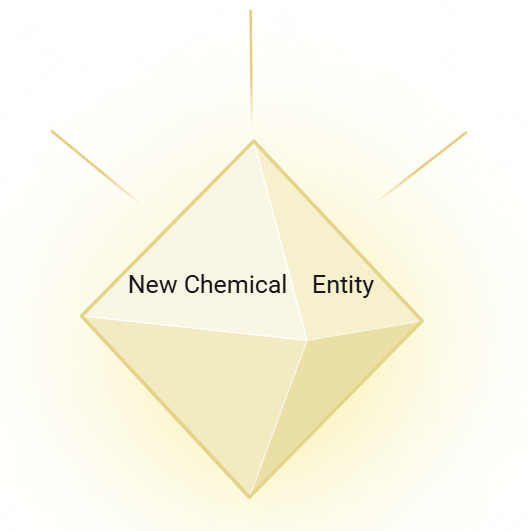
A new drug can be a multitude of things. The diamonds that pharma industry mines for are new chemical entities (NCEs) which are first in class “blockbuster drugs” for untreated diseases. Ozempic is a good example of a blockbuster because it is the first to treat obesity. There are also NCEs that increase therapeutic efficacy, that is, making an improved versions of a drug that is already on the market. NCEs can also increase therapeutic efficiency by easier administration routes or less frequent dosing.
To begin drug discovery, a company must first identify an unmet clinical need (an opportunity for business) and then perform target research as I mentioned earlier. After, they validate a target by understanding how it acts in cells in a dish or in animals. Finally, nonclinical safety studies are performed on animals to predict the likelihood of toxicity in humans and provide more information on the mechanism of action for the drug. Also around this time scientists quantify the appropriate dosage to start phase 1 clinical trials. You can see why we start to accumulate a huge price tag for drug development. Indeed, in 2023 alone, 20 big pharm companies spent 139 billion dollars on R and D.
Investigational New Drug Applications is a request and signal to the FDA
The IND document is around a four thousand page document that aims to transition the drug from pre-clinical to clinical phase. This is signalling to the FDA that you plan to start clinical trials and demonstrating pre-clinical data to support first usage in human studies. Pre-clinical refers to the phase before human (clinical) testing and involves animal and cell culture experiments. The IND describes the nonclinical data to support clinical usage and basic exposure data. It also demonstrates to the FDA that the identification, quality, purity and strength of the new drug are known. Finally, it has information on whether drug batches can be produced and consistently supplied and the clinical protocol to ensure human safety during the study.
The IND is a document that reflects years of studies to support the safety and efficacy of a drug. The FDA reviews it and determines within 30 days if it is reasonably safe to proceed with clinical trials. Once this happens, the company can begin its clinical trial. One important thing to note is that the eventual duration of the drug exposure in humans should not exceed the duration of exposure in animals, and the maximum does give to humans should not exceed the maximum “no observed adverse effect level” (NOAEL) dose in animal studies.
Trump’s plan to cap drug prices will ripple through the pharmaceutical industry
President Trymp’s “Most Favoured Nation” drug pricing policy caps U.S. Medicare payments for drugs at the lowest prices pried by other developed countries. In the short term, this does relieve U.S. patients while putting the burden on countries like Britain and Canada. As a Canadian this isn’t good news but in principle it will alleviate the burden Americans take on the drug prices. However, the drug prices help fund the copious amounts of research work involved during and before clinical trials.
55 % of the global research and development sector is supported by U.S investments and this leads to FDA approving 50 novel drugs in 2024. Capping the price of medicines might lead to a reduction in R and D projects, and thus limit future drug development and approvals. You might say, “hey, maybe Canadians and British people should be paying more for the bill of newly developed medicines” and you wouldn’t be wrong. However, Canada does not have an economically strong R and D industry like the U.S.. When Austria introduced a price-capped drug market, ultimately patients suffered since fewer innovative and first in class drugs were approved [2] . Pharmaceutical economics is not my niche, so I’m curious what you think about price-capping.
And there you have it: the drug discovery to IND pipeline. When the IND is approved the new drug can officially be tested in humans, and we’re off to the races with start of our clinical trial – phase 1. Catch you next week for the deep dive.
References
[1] Yiannopoulou, K. G., Anastasiou, A. I., Zachariou, V., & Pelidou, S. H. (2019). Reasons for Failed Trials of Disease-Modifying Treatments for Alzheimer Disease and Their Contribution in Recent Research. Biomedicines, 7(4), 97. https://doi.org/10.3390/biomedicines7040097
[2] Kakkar, A. K. (2021). Pharmaceutical price regulation and its impact on drug innovation: mitigating the trade-offs. Expert Opinion on Therapeutic Patents, 31(3), 189–192. https://doi.org/10.1080/13543776.2021.1876029
Thanks for the support Drew!