
I Tried Potato for the First Time
Yep, Potato (singular) the new AI co-scientist

I know, it’s a funny word for a biotech. A singular potato with a matching logo of a smiling, albeit squiggly, potato. The name comes from one of the classic beginner’s scientific experiments, making a battery out of a potato. Usually demonstrated in grade school, the potato acts as an electrolyte to facilitate ion movement to cerate a current and thus a battery.
Potato is the home to Tater, an “AI co-scientist” that can help run experiments “end-to-end”.
The company just closed its second round of funding with $4.5 M led by Draper Associates [1]. According to CEO Nick Edwards, Potato helps accelerate scientific research in the life sciences by making scientific processes automatable and more reproducible. The Potato team proposes their platform as a way to help scientists process the large amount of literature and methods currently published. Instead of reading articles for hours and comparing multiple studies, scientists can turn to Potato to compare research protocols across papers in the Potato database.
Potato uses Retrieval-Augmented Generation (RAG), a technique used by large language models (LLMs like ChatGPT) that can only answer users once they have referred to a specified set of documents. This allows users to curate their document sets (called collections) while limiting the hallucinations that other LLMs are challenged with.
Their website is quite sleek, and they four pricing plans. As I am a graduate student in one of the most expensive cities in Canada, I decided to try out the free version.
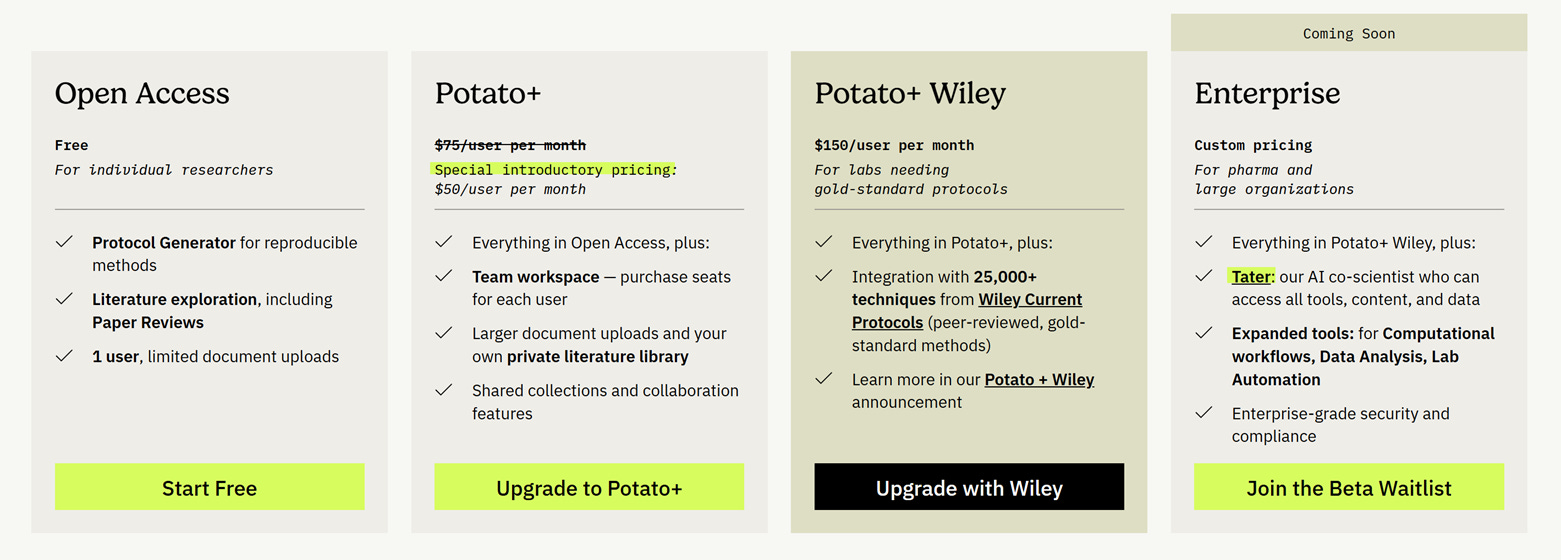
With this version, I won’t be able to access and test Tater which is the core of Potato’s product. Tater is the AI co-scientist that can write up research reviews, probe literature, and create research protocols. Furthermore, the enterprise paying option that comes with Tater also includes computational analysis workflows, data analysis and lab automation (this lab automation is not completely described).
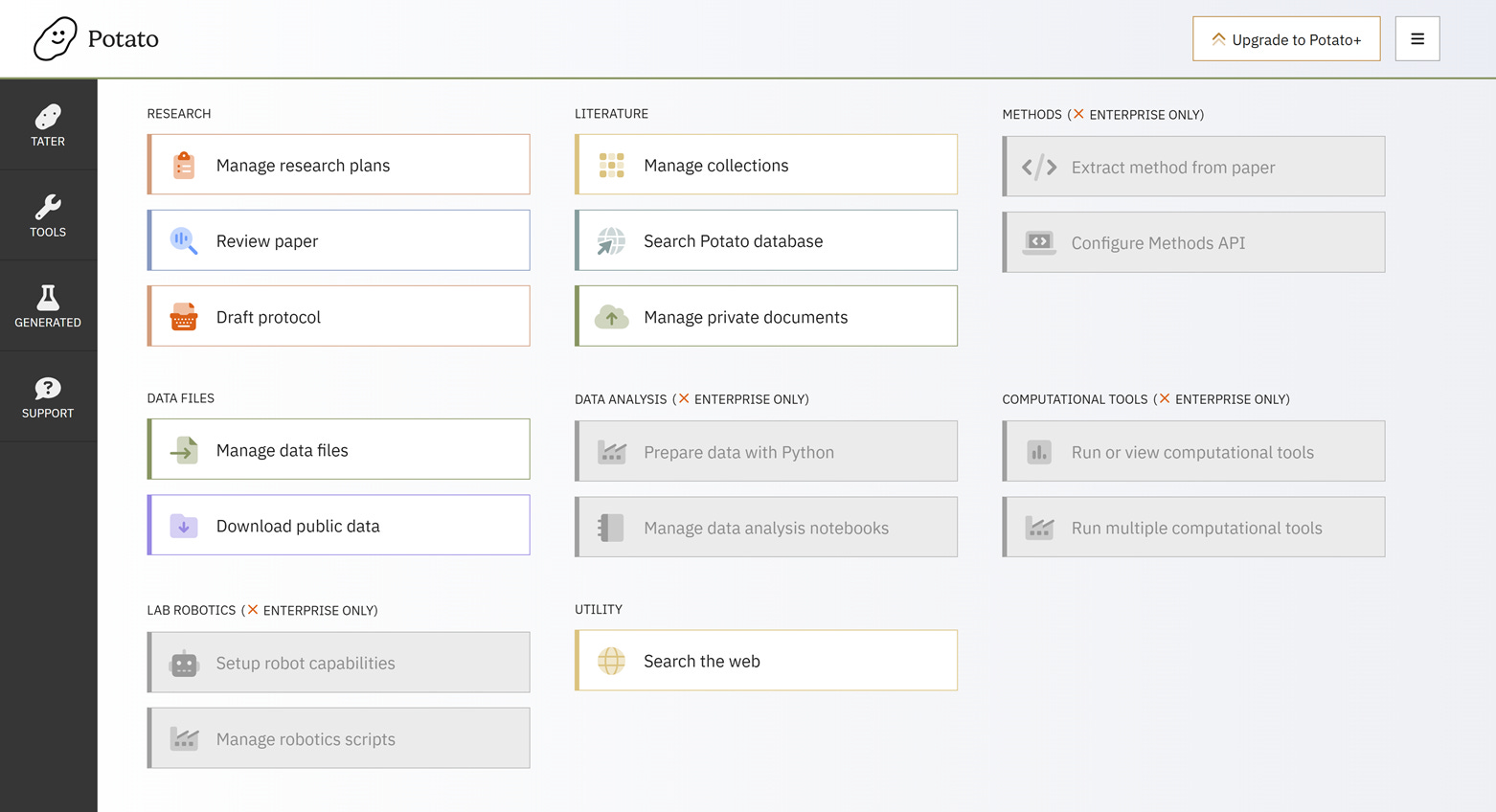
Here’s an overview of the homepage of Potato. You can see what parts of the platform I can access with a free account. For today’s post I will focus on reviewing the aspects of the program that I can use!
1. Collections
You can create your own collection (with a maximum of 3 documents for free users) with published articles, or you can prompt Potato to create a new collection for you. I tried both and asked the AI agent to make a report about sarcoma, a type of soft tissue cancer. To create a report, Potato searches for factsheets and documents. Its primary source of content comes from its recent partnership with Wiley. Wiley is an American publisher that is famous for textbooks but also owns multiple scientific journals such as Cancer, Hepatology, Journal of Geophysical Research, and EMBO journal.
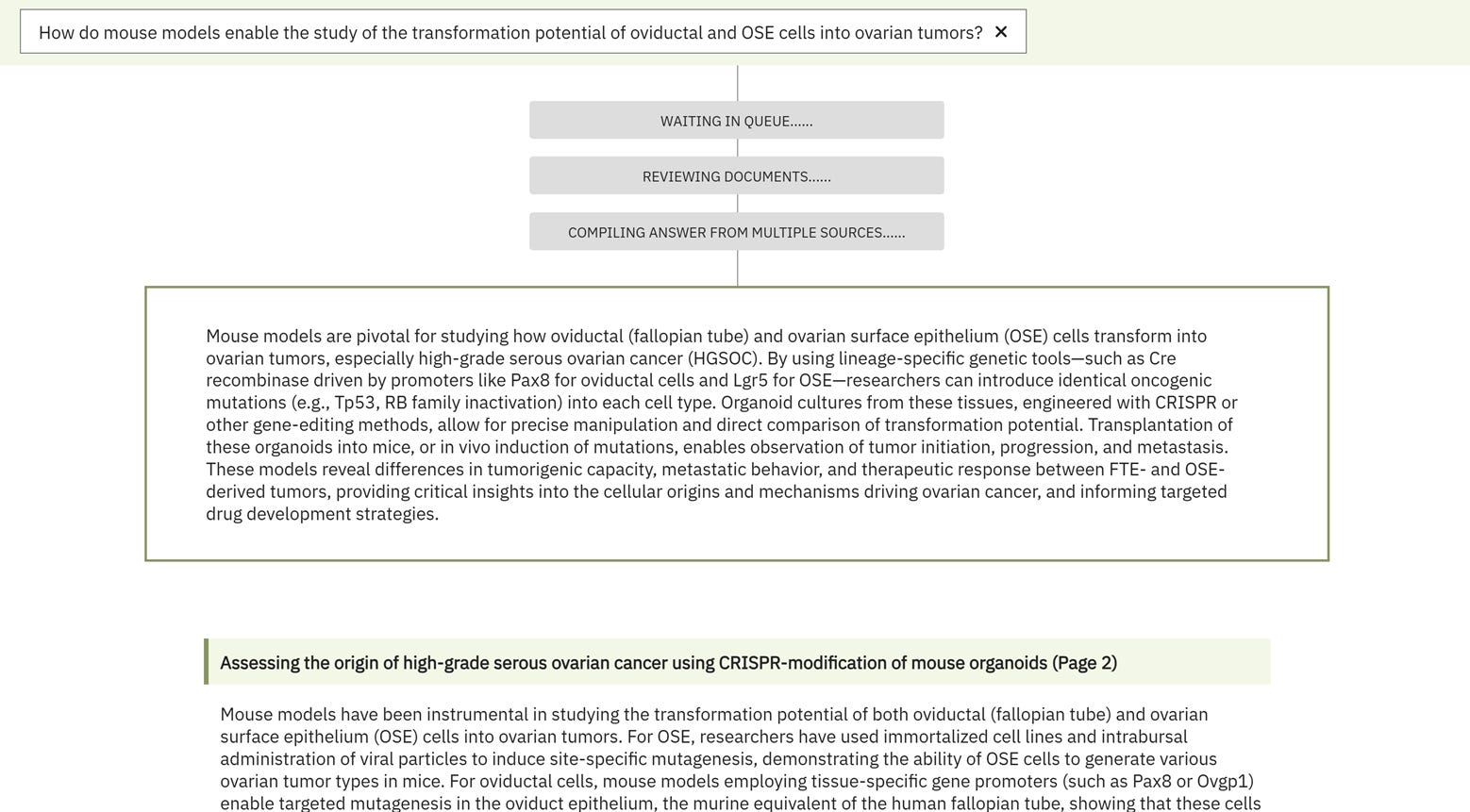
From each collection, you can ask specific questions that Potato will answer while citing a specific page from the scientific papers that is in the collection. Pictured below is a suggested question that Potato asked from my uploaded set of documents about ovary surface epithelium cells (OSE) and their role in high grade serious ovarian cancer.
See below an example of questions you can ask Potato. It’ll probe through your collection for an answer.
2. Protocol Bot
Now for the fun part! I asked Potato a question about a potential experiment I wanted to run. I was actually pretty impressed by its first response to my prompt which asked how I wanted to assess my results and what type of controls I wanted to use during my experiment. After I selected those, it offered a suggested protocol with the option for further feedback given in a check-style question list. After a bit more prompting, it generated a potential protocol. Regardless of the final output, I valued that I could see the “thinking” throughout its production.
Throughout its “thoughts”, Potato wrote each paragraph it cited from each paper in the collection I generated. I like looking over this feature to see if the extracted piece of information is relevant to the experiment I wanted to do.
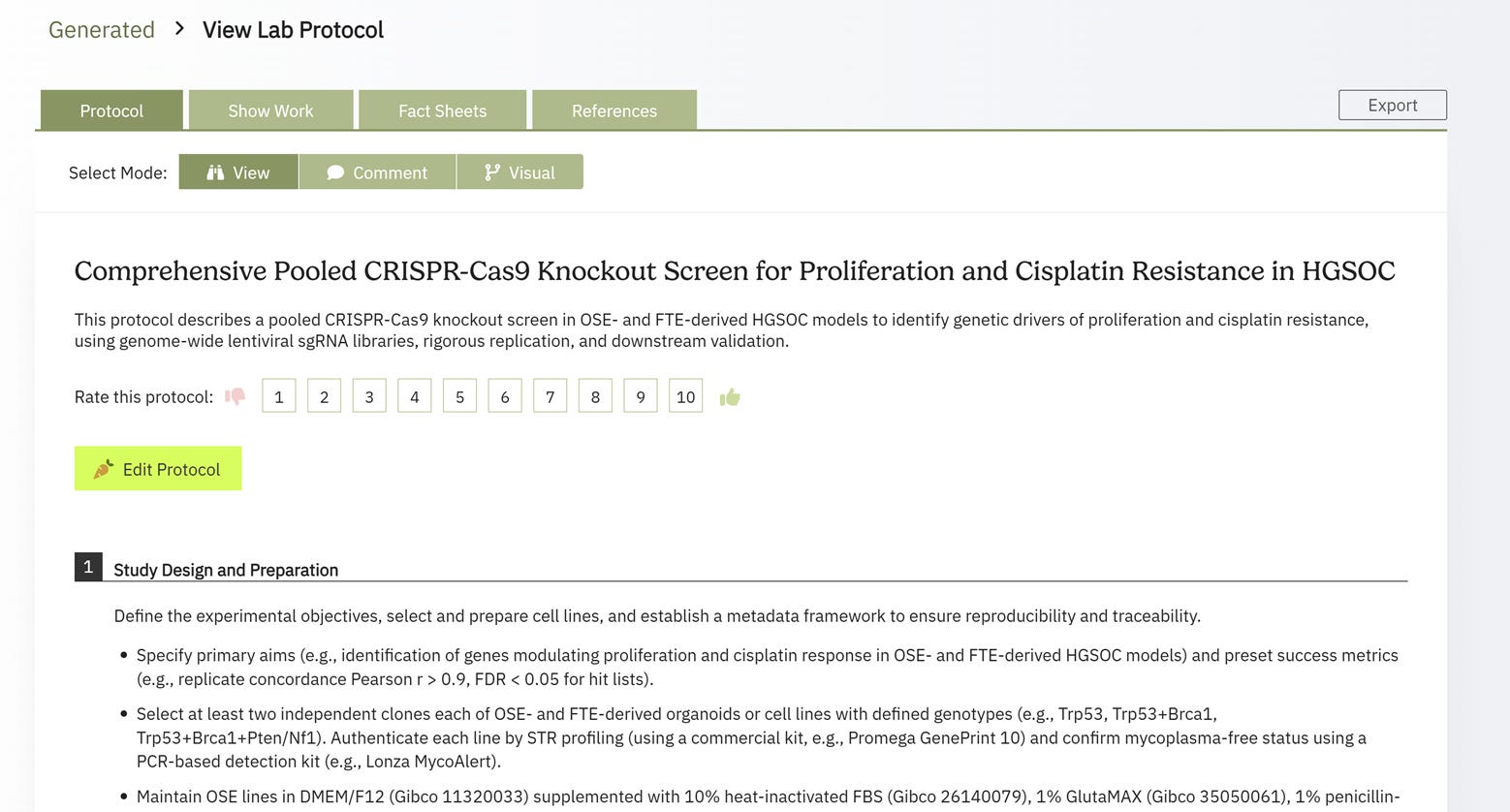
The protocol itself (pictured above) wasn’t anything ground-breaking. Since it’s only trained on existing data collection sets and publications, Potato can’t seem to create new protocols for different experimental questions left unanswered (at least with the free version). The protocol it generated for me included classic experimental procedures that I’ve used before with no contextual details about what could go wrong or ways to optimize the experiment.
3. Review Bot
The review bot was also an interesting tool because the design of the bot shows its thinking throughout the paper read. First, it shows how the bot broke down the given paper into multiple experiments, as well as advantages and limitations of each. It concludes with an overall summary of the paper, strengths, concerns, and further research. I think the review bot is also constrained to basic analysis and surface level understanding of the topic at hand. It does not provide critical or valuable insight into the experimental process. I can see these tools being useful for studying fields outside of my area of expertise such as immunology. However, most scientists working in biotech and pharma are skilled experimentalists, and I don’t think Potato adds anything novel or of value to their assessments of literature [2].
Are we creating problems so that we can solve them with AI?
There is absolutely nothing wrong with attempting to cut scientific costs. Drug development can reach exorbitant amounts of up to 4 billion USD. I also don’t think there’s anything wrong with using AI tools to accelerate research. In Potato’s case they believe that a trained AI Model can extrapolate essential details of multiple protocols and fine-tune those for customer’s desired needs.
However, I think there remains value in reading, understanding, and criticizing protocols from multiple papers as a scientist. When an AI agent does this for you, not only do you lose all the context from which said method was designed and executed in, but you also lose the vital skills of critical thinking and the opportunity to expand your knowledge base.
One of Potato’s selling points is that not every scientist can be an expert in every topic, which is where the AI co-scientist can help fill knowledge gaps. I would argue however that a key to discovery in the life sciences is collaboration. Collaboration with real humans with different expertise, training type, and experiences can ignite new ideas and push discovery. Without human interaction, we lose our creative spark and analytical skills which I believe are two vital aspects of being a scientist.
Potato, and platforms like it, do have their place in computational data analysis and lab automation where robotics helps experiments become more precise and reproducible. They will truly help increase experimental output and decrease time investment. For example, a machine can pick up the same sized square from a tissue slide perfectly 100 times in a row while even the most precise humans cannot. However, for the aspects of Potato like literature review and protocol creation, a human scientific opinion is much more valuable. It’s important to be able to critically read papers in your area of expertise and communicate your problems effectively across disciplines. That is where true discovery happens.
That’s it for this week! Let me know what your opinions are and see you next week!
Footnotes
[1] Draper has also invested in Tesla and other tech focused companies.
[2] Some other tools that I didn’t write about include the Potato Database which allows you to search four Protein, Compound and Topic databases at the same time by ID or name search.