
The Science Behind Bike Commuting
And 3 reasons why I support it

For 50 minutes a day, it’s just me on 2 wheels. I am an avid bike commuter and a huge advocate for more people to try this method of commuting. Sometimes I talk about cycling so much that it seems like the second most important part of my personality (after being a dedicated grad student of course 😊). In this article, I am going to go through some reasons why cycling is my favourite way to get around and the scientific benefits associated with moderate cycling.
1. Cycling keeps me healthy and is better for the environment
Even though I spend just a little bit of time on the bike each day, these minutes add up. I’ve noticed that I can run for longer periods of time after I’ve been cycling consistently to and from work. This is also reflected in many scientific studies.
When researchers are probing for a perceived change in an outcome after an activity over a certain period of time they may choose to implement longitudinal studies. These types of studies follow the same group of volunteer participants over several years and track values of interest over that time span. Longitudinal studies are frequently used in public health to monitor risk factors associated with developing diseases like cancer or heart failure. The longest ongoing longitudinal study is currently 86 years old!
In a Scottish Longitudinal Study from 2024, bike commuting was associated with lower risk of any hospitalization, lower risk of cardiovascular disease, and a lower risk of cancer mortality and hospitalization. This study tracked around 82 000 people across 17 years to conclude that bike commuting in comparison to non-active commuting reduced risk of any hospitalization and medication for poor mental health.
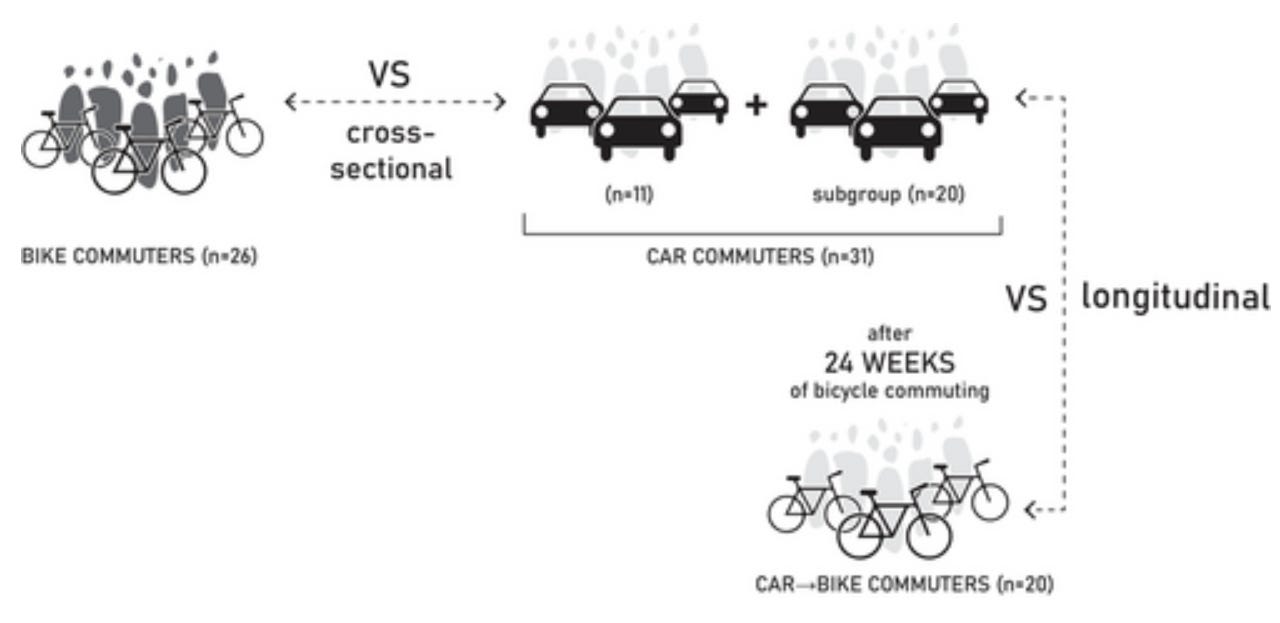
Furthermore, another study performed in Northern Italy published in 2025 compares car commuters to bike commuters and showed that bike commuting was associated with a higher exercise tolerance, a greater aerobic power and improved skeletal muscle oxidative input. The researchers also concluded that CO2 output was 12 times lower for cyclists compared to the same distance travelled by car, demonstrating the positive environmental impact of this commuting option.
Interestingly, the Italian study used both a longitudinal approach and a cross sectional study design approach. A cross-sectional approach samples two groups of people at one moment of time, with the aforementioned study sampling both bike commuters and car commuters simultaneously. They then followed a group of 20 volunteers who agreed to commute by bike for 6 months instead of using their car (the longitudinal section of the study).
2. A bit of physical activity at the beginning of the day wakes me up and is a great stress reliever at the end of the day
You might have heard about “runner’s high” – the feeling that runners get after exercising that makes them feel that they can conquer the world. That’s how I feel when I finish my around 25 minute bike ride to work in the mornings. I am not a morning person by any means; in fact, I can be quite grumpy when I have to go to work early. But I am a completely different person once I hop off my bike. I am excited and ready to conquer the day. So, what’s happening scientifically here?

An aerobic physical activity is any activity that uses multiple muscle groups rhythmically like running, cycling, boxing, and swimming. Anaerobic activities are brief exercises done near maximal efforts like trying to lift very heavy weights. During aerobic activity your heart rate increases to pump more oxygen to your muscles.
This increase in heart rate releases endorphins, which explains why I find my commute to be a decompressor after a long or stressful day at work. Endorphins are a neurotransmitter and can be though of as your body’s natural painkiller. They are released by the hypothalamus and pituitary gland and block the perception of pain in the brain by activating opioid receptors.
3. It’s faster than commuting on the train
I don’t have any scientific evidence to support this opinion so you’re just going to have to trust my anecdotal recounting. It’s about 25 minutes door-to-door for me from home to the lab by bike, whereas if I take the TTC (Toronto Transit Commission where I use the train referred to as the subway) it takes me up to 40 minutes. Also, not a week goes by without a delay on the TTC nowadays, and nothing beats the awesome views I get biking down to the city.
All in all, I really enjoy bike commuting during the warmer months in Canada, and I hope this article encourages you to either continue biking or to maybe join a bikeshare program in your city to reap the awards of bike commuting! See you next week!