
Clinical Trials for Non-Scientists: Phase II
The first test of human efficacy for a new drug

Welcome back to my series describing each phase of clinical trials. Today, I’ll be discussing phase 2 – the first test of a new therapy in patients. You can also take a read of my earlier posts about pre-phase 1 and phase 1 stages as well.
The main goal of phase 2 is to test the efficacy of a new drug while also gaining more insights into the safety profile of the drug. While phase I is monitoring adverse side effects in a small group of healthy volunteers, phase II expands to test in a larger number of patient volunteers. Thus, we might see more side effects in a larger group of patient volunteers. This group of volunteers can be up to several hundred people and can last from several months to 2 years.
We call participants in clinical trials volunteers because clinical trials are research to test a new treatment in humans for the first time. Before this there is no human data that shows efficacy for the drug. So, this group of people are volunteering for a trial to contribute to research data but might not personally benefit if the treatment proves ineffective. These volunteers (patients for phase 2) are helping to answer the following questions:
“Does the treatment work in the disease population?”, and “is it safe to proceed with a phase 3 clinical trial?”.
What is a clinical trial “arm”?
You might read or hear the reference to “arms” in clinical trials. Arms annotate how many times our volunteer group is split up throughout drug testing. For example, if you have a “2-arm” clinical trial that means there are two arms that split off from the original population: the first arm or group of patients is tested with the investigational new drug while the second arm is tested with a control medicine (usually a placebo or sugar pill).
We would prefer a randomized phase 2 trial with a control arm because randomized ensures there is no bias to choosing which volunteers receive the new treatment, and 2-arms allow us to compare to a placebo. However, single-arm designs could be good for testing drugs designed for rare diseases because they don’t need as many patients; ideal for rare diseases with lower patients. In phase 2 we are not comparing the treatment to an existing treatment to see if it performs better – this usually happens in phase 3.
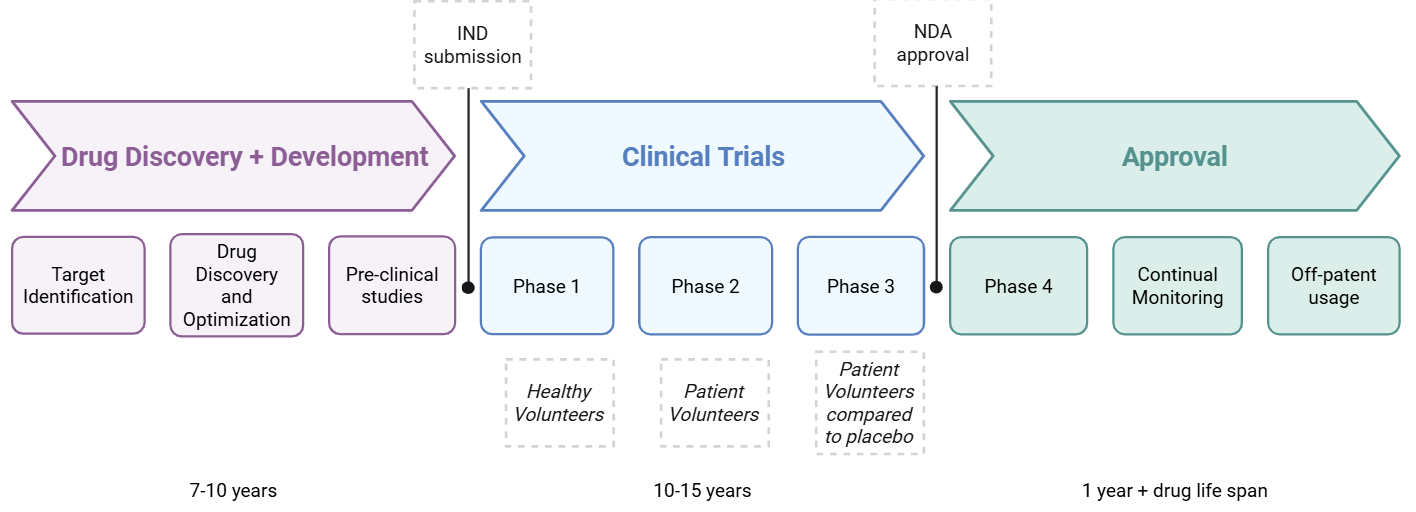
Clinical Trial design is flexible depending on the situation
The rigidity in clinical trials might not be as tight as you think. If toxicity is too high in healthy patients, then phase 1 and phase 2 might be combined to test in patients first. Furthermore, phase 2 can be shortened if there is sufficient data on the mechanism of action and strong evidence of effectiveness. On the other hand, phase 2 might be lengthened if the new drug is intended to treat a chronic disease or long-term condition.
How do the statistics stack up for phase 2 clinical trials?
Approximately 33% of drugs that enter phase 2 move on to phase 3 clinical trials. The majority of drugs fail during phase 2 because they are not effective. Before each clinical trial in phase 2, scientists set goals to demonstrate effectiveness. For example, you can look for a decrease in a protein or molecule of interest (a biomarker) that shows the drug is acting in the way you want to. Drugs that fail in phase 2 might not significantly decrease a biomarker of interest or struggle with weak potency and do not reach the target of interest in high enough concentrations.
When Phase 2 and Phase 3 disagree
Although I haven’t touched on phase 3 yet (stay tuned for next week’s post!) it is the most pivotal phase for confirming efficacy. In the 3rd phase the new drug is tested in a larger group of patients and usually compared to an existing standard of care or drug available on the market. Naturally, since phase 2 is just a larger version of phase 3 you might expect to see a few more noted side effects and a continuation of the effects noted in phase 2. However, this isn’t always the case. There are many reasons why phase 3 can have different results from phase 2 as described below.
The Phase 2 monitored endpoint might not actually reflect desired result for phase 3
In phase 2, we monitor for a change in a primary endpoint usually relating to the mechanism of the new drug. For example, if we believe a drug is lowering the “bad” type of cholesterol called low density lipoprotein (or LDL) we will look for decreases in LDL in the blood of our phase 2 volunteers. However, the drug’s noted decrease in LDL in blood samples as noted in phase 2 trials might not translate to a better clinical outcome like reducing heart attacks or increasing patient longevity. This is exactly what happened with Pfizer’s failed drug torcetrapib.
The same thing happened with Eli Lilly’s drug semagacestat for Alzheimer’s disease. In Phase 2 the drug was seen to decrease amyloid-beta plaques in the brain, whose build-up was thought to be associated with Alzheimer’s severity. Despite phase 2 showing a decrease of amyloid-beta in the blood, a phase 3 trials with more than 1000 patients was terminated because of a worsening cognitive function compared to placebo. Despite the fact that amyloid beta levels in these patients were still decreased, the drug also induced more adverse events like infections and skin cancers.
I am not writing this to scare you
The reality of drug discovery is that there are many failures, and even more so when a disease is complex and misunderstood. It is harder to bring therapeutics to market since the diseases left are “high-hanging fruit” such as Alzheimer’s and dementia or complex disease types. We have a plethora of efficient FDA approved drugs for conditions like heart failure and infections. The reality of clinical trials is that they are a huge risk and step into the unknown. However, without these trials and the pre-clinical research that occurs before a new drug hits the market, we cannot take steps to better understand diseases and how to therapeutically target them. They are vital to help bring new medicines to patients.
With that, I’ll end this week’s post. See you next week for phase 3 clinical trials!
Drug testing would be much more simpler, faster, and more cost effective - if we simply focused on Pharmacokinetics. If we did this, we would not need a small group of people or a larger number of patients and so much time and money etc. With a pill for example all a lab has to do is watch what happens as soon as it enters the mouth and is met with enzymes, then on down to the stomach, intestines, liver and kidneys where other natural organic dynamics "destroy the pill". Destroy is not the word they use - it's a naughty word, even thought it is the correct word. The word science uses instead is the pill gets "metabolized" (aka, destroyed).
The molecules that are assembled to make a pill be come undone, not just the pill as a whole, but the individual molecules. Some molecules might escape the gauntlet of natural body defenses (the body is adroitly designed to defend against foreign, alien matter, especially toxic components which are the bulk of a pills ingredients) - but that amount is also on its way out via pee and poop. Certain drugs, like uppers and downers can make their way to the nervous system and have effect, but most drugs are not to be stimulants and depressants.
The largess of pharma drugs aim to go into the body, remain intact and positively impact the body - but not one drug can make this claim, can speak to this kind of success.
And what is important to remember is that as the body battles to sustain homeostasis, it takes a toll. The battle we engage when the body fights drugs and other foreign elements can be a fierce one, most times we win, some times we lose the battle, but each time, each battle, the body is a little more scarred.
The body has the great capacity to heal, to replenish cells, but a continued onslaught of drug intake will take its toll and organs will begin to tap out and fail - especially the liver and kidneys which are the first lines of defense for things that get into the blood.
Finding truly effective ways to deliver a drug into the body has forever been the bane of the pharmaceutical business. And still, in the year 2025 we have not at all succeeded in this area - and drugs still get approved. We feel testing for 2 or 4 years is adequate but many times the deleterious effects of drugs is not sudden but gradual. And yes, for many, the negative impact is immediate. Oliver