
Why So Many Drugs Fail in Phase 3 Clinical Trials
Clinical Trials for Non-Scientists: Phase 3 & 4

Welcome back or welcome to my series describing clinical trials to a broad audience. Today, we’re diving into the 3rd and 4th phases of clinical trials. Results from phase 3 drive an investigational new drug to be approved as a treatment. Many drugs fail in this phase, but why? I’ll be exploring the answer to this question and going through examples of failures and success.
So, what has happened to the investigational new drug thus far? First, it went through phase 1 trials which tests the safety of the drug in healthy volunteers. Following safe results, the drug enters phase 2 trials which further monitors for toxic side effects and tests for some efficacy in patient volunteers.
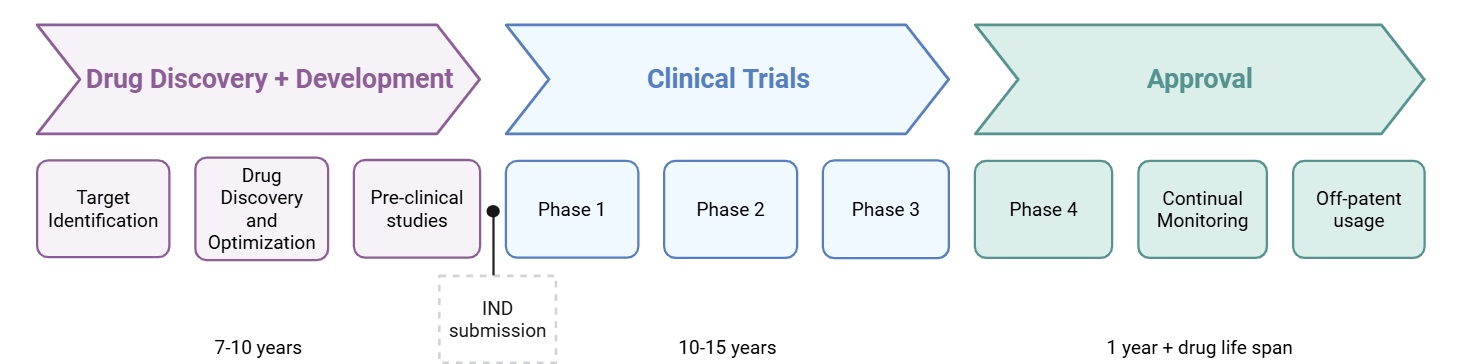
Phase 3 is the ultimate test for investigational new drugs
Phase 3 usually involves a larger number of patients, and importantly it tests the new drug to a current standard of care or treatment. So not only does the drug need to show its safety, it also needs to beat the current benchmark for treatment. As I mentioned in my post about phase 2 trials, results from phase 2 and 3 trials do not always agree with each other.
We have Sanofi’s Iniparib for treatment of triple negative breast cancer as an example. This subtype of breast cancer is quite aggressive because it does not have any of the three receptors over-expressed in other breast cancer types which limits its treatment options. Iniparib showed an increase in survival and response when combined with a standard chemotherapy in phase 2 trials (123 patients). However, phase 3 trials with 519 patients did not show an improvement in survival when added to standard chemo treatment.
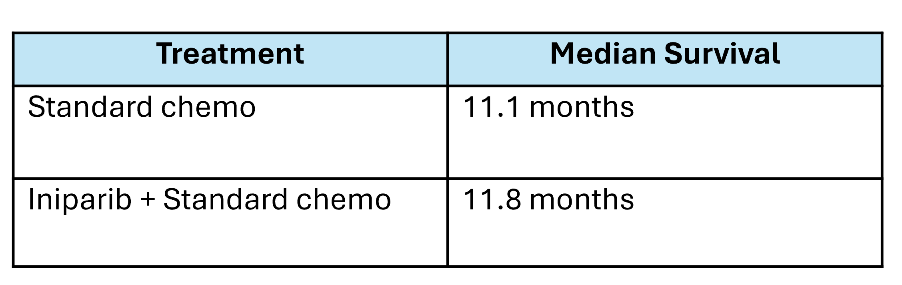
Iniparib was previously thought to be a PARP (poly ADP-ribose polymerase) inhibitor, which stops cells being able to repair single-stranded DNA breaks. Upon further investigation, iniparib was shown to be a poor inhibitor of PARP. Actually, iniparib’s ability to kill cancer cells in pre-clinical data was not mediated by PARP inhibition but rather through mechanisms related to reactive oxygen species regulation. This demonstrates the important of validating the mechanism of action and creating reproducible data in pre-clinical studies before moving drugs into clinical trials.
Why do drugs fail in phase 3?
There are a variety of reasons why drugs fail in phase 3. The percentage of phase 2 and 3 clinical trials terminated before completion increased from 11% of trials annually in 2013 to 23% in 2023 (percentage being of all trials finishing that year). The authors found that just over 30% of trials were terminated for strategic and business reasons which could include things like better performance of competitor drugs in other trials, other indications for the drug in clinical trials, or reassessment of commercial potential and the company’s drug portfolio.
Following business or strategic reasons, the next most common reason for clinical trial termination is efficiency. Lack of efficiency encompasses about 24% of all terminated clinical trials and means that the drug did not meet defined endpoints for betterment of disease state. Importantly, this percentage of failed drugs due to efficiency increases to 50% when you account for trials that completed phase 3.
This efficiency problem has consistently plagued Big Pharma. No matter how promising a drug might look, sometimes it simply does not improve the pre-determined clinical endpoints, or it can’t beat the current standard of care.
How do we improve the failure rate in phase 3 clinical trials?
I think this is a question many scientists, clinicians, biotechs, and pharma companies have asked themselves. From a scientific perspective, we’re always chasing the next best model. The model that will truly mimic human disease. The development of cell culture began in the early 1900s, mice have been around for a while too, and organoids or 3D cell culture in the early 2000s. Fast forward to today where we’re artificial intelligence and machine learning to try and design models that can accurately mimic human disease.
Another argument for the failure of drugs in phase 3 is the idea that the drug itself is effective, but the clinical trial design is not designed properly to show this efficacy. This is reflected in drugs that get approved after failure in new phase 3 trials that monitored either another endpoint or a different disease. For example, San-Francisco based biotech Vistagen owns Fasedienol, an activator of olfactory receptor cells, to treat social and anxiety disorder. Fasedienol failed its phase 3 clinical trial and was unable to meet its primary endpoint of subjective units of distress scale measured in adults during a public speaking challenge. However, the drug is safe, and Vistagen plans to meet with the FDA to run another phase 3 trial after analysing a subpopulation of the clinical trial data and demonstrating a significant decrease in their primary endpoint in adults with very severe social anxiety.
About 10-20% of drugs that start phase one clinical trials pass through phase 3. This success rate is higher depending on the type of drug; indeed, enzymes or stimulants have about a 30% success rate in clinical trials. After phase 3, what happens next?
NDA writing and application
After positive results from phase 3, the pharmaceutical company or company owning the drug must compile all the data and documents to write a new drug application (NDA) that is submitted to the FDA. This usually takes about 6-12 months.
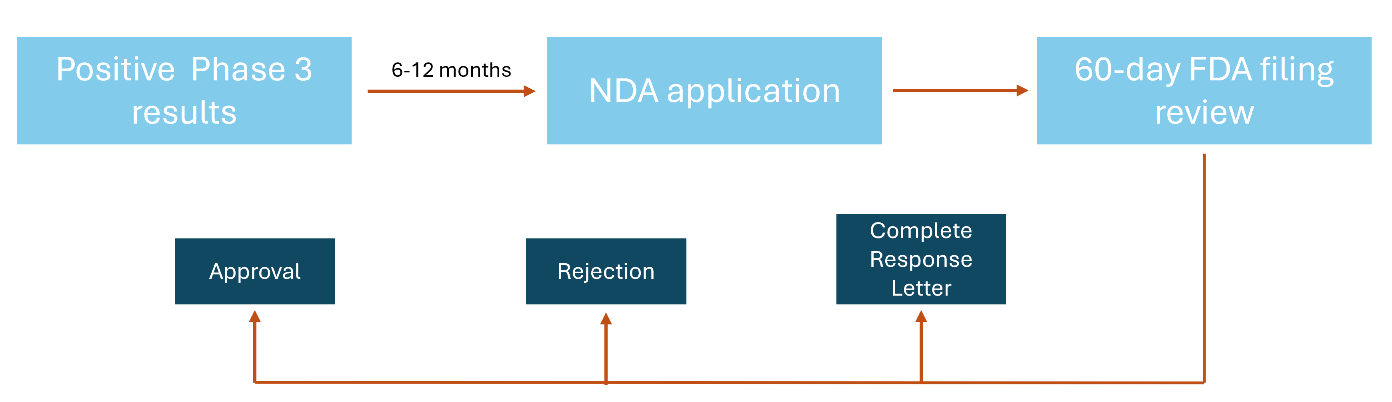
Once the FDA receives the NDA, the filing review takes place. This is a period of 60 days where the FDA conducts a first-pass assessment where the application is deemed sufficient for review or rejected (usually requiring more data before another application). After the 60 day filing review, they have a window of 10 months to respond with an approval, rejection, or a letter describing the need for more data before another application and review. This review, as detailed in the Prescription Drug User Fee Act, ensures that the drug is efficacious and safe and is performed by the Center for Drug Evaluation and Research, which includes physicians, scientists, and lawyers. But hold on! The trials don’t stop there.
There is always a level of pharmacovigilance with new drugs, and this is reflected in the existence of phase 4. Phase 4 is known as post-marketing surveillance, where the new drug is on the market and available for patients. Pharmacovigilance refers to the observation of these patients for adverse side effects to better understand a drugs long term effects on a large population.
It can be challenging to retain the patients for long-term monitoring in phase 4 trials, and the large and complex data from these trials can also be complicatedto analyze. And even when patients are recruited for a phase 4 trial, the small number of patients means it is statistically more challenging to detect adverse events. However, successful phase 4 trials open possibilities for different indications of new drugs or target therapeutic options. For example, the infamous thalidomide drug which caused birth defects in 10 000 children from mothers ingesting the medicine for morning sickness in the 1960s, was successfully retested and approved for advanced renal cancer, esophageal cancer, endometrial and pancreatic cancer.
That wraps up this clinical trial series! Thanks for reading and let me know what you think about the future of drug and clinical trial design.
Really enjoyed this breakdown, had no idea that thalidomide ended up being repurposed!
Interesting. AI should change that fairly quickly.